

Visa Bulletin 2026: EB-1 and EB-2 dates, what Current means
October 2026 Visa Bulletin explained: EB-1, EB-2 and EB-3 dates for every country, Final Action vs. Dates for Filing, and when you can file Form I-485.
Contents15
- What the Visa Bulletin is, in plain words
- Where to check
- Two ways to the green card after I-140 approval
- How to read the bulletin, step by step
- Two charts: Dates for Filing vs. Final Action Dates
- What Current (C) and U mean in the Visa Bulletin
- October 2026 Visa Bulletin: EB-1 and EB-2 dates
- What the bulletin says about the coming months
- How to find your priority date and compare it with the bulletin
- "All Chargeability Areas": what it means
- Cross-chargeability: an option for people born in India or China
- Visa retrogression
- History: how the EB-2 line appeared and where it stands now
- Glossary
- FAQ
November 2026 Visa Bulletin dates: employment and family categories
In the November 2026 bulletin, for All Chargeability (everyone born outside China, India, Mexico and the Philippines): EB-1 is Current in both charts (no line); EB-2 Final Action is April 1, 2025 and Dates for Filing is March 15, 2026. Compared with the October 2026 bulletin: EB-2 Final Action moved forward from January 1, 2025 to April 1, 2025.
Check your date Saved for your next visit
Visa Bulletin for November 2026: travel.state.gov. Not legal advice.
Employment-based: Final Action Dates
| Category | All Chargeability | China | India | Mexico | Philippines |
|---|---|---|---|---|---|
| EB-1 | C | 01AUG23 | 01FEB23 | C | C |
| EB-2 | 01APR25 | 01OCT21 | 01NOV13 | 01APR25 | 01APR25 |
| EB-3 | 15JUN24 | 22JAN22 | 22JAN14 | 15JUN24 | 15AUG23 |
Employment-based: Dates for Filing
| Category | All Chargeability | China | India | Mexico | Philippines |
|---|---|---|---|---|---|
| EB-1 | C | 01JUL24 | 01JUL24 | C | C |
| EB-2 | 15MAR26 | 01JAN23 | 15JAN15 | 15MAR26 | 15MAR26 |
| EB-3 | 01AUG24 | 01APR24 | 15JAN15 | 01AUG24 | 01JAN24 |
Family-sponsored: Final Action Dates
| Category | All Chargeability | China | India | Mexico | Philippines |
|---|---|---|---|---|---|
| F1 | 22JAN21 | 22JAN21 | 22JAN21 | 22SEP08 | 01NOV13 |
| F2A | 22OCT26 | 22OCT26 | 22OCT26 | 22APR26 | 22OCT26 |
| F2B | 22AUG20 | 22AUG20 | 22AUG20 | 15MAY10 | 01OCT13 |
| F3 | 22OCT15 | 22OCT15 | 22OCT15 | 15JUL01 | 22JUL06 |
| F4 | 22OCT12 | 22OCT12 | 15DEC06 | 22APR01 | 15MAY08 |
Family-sponsored: Dates for Filing
| Category | All Chargeability | China | India | Mexico | Philippines |
|---|---|---|---|---|---|
| F1 | 01FEB21 | 01FEB21 | 01FEB21 | 01DEC08 | 22APR15 |
| F2A | C | C | C | C | C |
| F2B | 01SEP20 | 01SEP20 | 01SEP20 | 22MAR11 | 01OCT14 |
| F3 | 01NOV15 | 01NOV15 | 01NOV15 | 01DEC02 | 22OCT06 |
| F4 | 01NOV12 | 01NOV12 | 01FEB07 | 30APR01 | 22MAR09 |
How the dates moved over 12 months (All Chargeability)
| Bulletin | EB-1 Final Action | EB-2 Final Action | EB-2 Dates for Filing |
|---|---|---|---|
| Nov 2026 | C | 01APR25 | 15MAR26 |
| Oct 2026 | C | 01JAN25 | 15MAR26 |
| Sep 2026 | C | C | C |
| Aug 2026 | C | C | C |
| Jul 2026 | C | C | C |
| Jun 2026 | C | C | C |
| May 2026 | C | C | C |
| Apr 2026 | C | C | C |
| Mar 2026 | C | 15OCT24 | C |
| Feb 2026 | C | 01APR24 | 15OCT24 |
| Jan 2026 | C | 01APR24 | 15OCT24 |
| Dec 2025 | C | 01FEB24 | 15JUL24 |
C (Current) means there is no line. A date means that people whose priority date is earlier than that date can file now (Dates for Filing) or get the green card now (Final Action).
EB-3 here is skilled workers and professionals; the bulletin lists other workers in a separate row. F1: unmarried sons and daughters (21 or older) of U.S. citizens. F2A: spouses and unmarried children (under 21) of green card holders. F2B: unmarried sons and daughters (21 or older) of green card holders. F3: married sons and daughters of U.S. citizens. F4: brothers and sisters of adult U.S. citizens.
Which of the two charts USCIS accepts for Form I-485 this month is on the USCIS page Adjustment of Status Filing Charts.
Source: U.S. Department of State, Visa Bulletin for November 2026, data as of October 28, 2026.
The State Department publishes a new bulletin once a month, usually in the middle of the month before. We update this table once a month.
What the Visa Bulletin is, in plain words
The Visa Bulletin is a monthly chart from the U.S. Department of State. It shows which countries and green card categories have immigrant visa numbers available right now.
Think of a line at a deli counter. An approved I-140 petition is your ticket, but you only get the green card when your number is called. The bulletin shows which numbers are being served this month. If yours has come up, you can file for the green card. If not, you wait.
Why the line exists
The law caps green cards: at least 140,000 a year for all employment-based categories (EB-1 through EB-5), plus whatever family numbers went unused the year before. There is a country cap too. No single country of birth can take more than 7% of all family and employment numbers combined. When more people qualify than there are numbers, a line forms.
Who it affects
- EB-1A / EB-1B: usually no line (Current) for most countries
- EB-2 (including NIW): there may be a line, depending on your country of birth
- O-1: not affected at all, because it is a nonimmigrant work visa, not a green card
It is your place in line, usually the day USCIS received your I-140 (or the day the Department of Labor accepted your PERM). It is printed on your Form I-797 notice, next to the receipt number.
C (Current) means visa numbers are open to every qualified applicant, whatever the priority date. If you are in the U.S. you can file the I-485 right away, even together with the I-140. A date in the cell means your priority date has to be earlier than it.
Where to check
The latest bulletin
travel.state.gov/visa-bulletin - a new issue comes out every month, usually in the middle of the month before (the May bulletin appears in mid-April, for example).
Which chart USCIS uses this month
USCIS - Adjustment of Status Filing Charts - every month USCIS says whether it accepts I-485 filings under Final Action Dates (Table A) or Dates for Filing (Table B). More on that below. Check it before you file.
Two ways to the green card after I-140 approval
Once your I-140 is approved and your date in the bulletin is Current, there are two paths to the green card:
Adjustment of status (I-485) - if you are in the U.S.
You file Form I-485, Application to Register Permanent Residence or Adjust Status. It changes your current status (F-1, H-1B, O-1, B-1/B-2 and so on) to permanent resident, and you stay in the U.S. for the whole process.
Consular processing (DS-260) - if you are abroad
You file Form DS-260, the immigrant visa application, through the National Visa Center (NVC). You go to an interview at the U.S. embassy or consulate that handles immigrant visas for your country, get the immigrant visa, enter the U.S. and receive the green card.
O-1 and the bulletin:
The O-1 is a nonimmigrant work visa, so the bulletin does not apply to it. If you are on an O-1 and want a green card, you need a separate I-140 petition under EB-1A or EB-2 NIW. The bulletin starts to matter only after that I-140 is approved.
How to read the bulletin, step by step
Open the "Final Action Dates" chart (Table A)
This is the main chart. Look for the "Employment-Based" section.
Find your row
- "1st" = EB-1 (EB-1A, EB-1B, EB-1C)
- "2nd" = EB-2 (including NIW)
- "3rd" = EB-3
- and so on
Find the column for your country of birth
- "All Chargeability Areas Except Those Listed" = every country except China, India, Mexico and the Philippines
- "CHINA-mainland born" = mainland China
- "INDIA" = India
- "MEXICO" = Mexico
- "PHILIPPINES" = the Philippines
Read the result
- "C" (Current) means no line: you can file for the green card right away, even together with the I-140
- A date (for example "01JAN22") means your priority date has to be earlier than that date. If your date is later, you wait.
EB-1 and EB-2 are both employment-based preference categories.
EB-1, first preference: priority workers. It sits at the top of the employment-based line.
EB-2, second preference: members of the professions holding advanced degrees, or people of exceptional ability.
Two charts: Dates for Filing vs. Final Action Dates
Every bulletin has two charts, and this is where many people get confused:
Chart | What it means | What it is for |
|---|---|---|
Table A: Final Action Dates | When the green card can actually be issued | Your case can get final approval |
Table B: Dates for Filing | An earlier date that lets you file the I-485 | You can file sooner and get a work permit (EAD) and advance parole |
Why Table B matters in practice:
If USCIS says it accepts Dates for Filing (Table B) this month, you can file the I-485 before your date is Current under Table A. That gets you two things while you wait:
1. EAD card (Employment Authorization Document) - you can work for any employer, not only your visa sponsor
2. Advance Parole (travel document) - you can leave the U.S. and come back without abandoning your green card application
USCIS cannot approve the case until your date is Current under Table A, but the EAD and advance parole are yours to use in the meantime.
USCIS says it every month on its Adjustment of Status Filing Charts page: Final Action Dates (Table A) or Dates for Filing (Table B). Check that page before you file; the date check on this page uses the current bulletin.
Yes, in a month when USCIS accepts Dates for Filing. You can file before your date is current under Final Action, and while you wait you can get a work permit (EAD) and advance parole. The green card itself is issued only when Final Action reaches your date.
What Current (C) and U mean in the Visa Bulletin
A cell holds either a date or one of two letters. The State Department defines them in every issue: "C" means current, i.e., numbers are authorized for issuance to all qualified applicants; and "U" means unauthorized, i.e., numbers are not authorized for issuance.
- C (Current) - visa numbers are open to every qualified applicant, whatever the priority date. No line: if you are in the U.S., you can file the I-485 right away, even in the same package as the I-140 (concurrent filing).
- A date (for example 01JAN25) - more people want numbers in this category than there are numbers. Only people with a priority date earlier than that date can get one.
- U (Unauthorized) - nobody can get a number in this category this month, no matter the priority date. This happens, for example, when the annual limit has run out.
Sources: the October 2026 Visa Bulletin and the USCIS page on concurrent filing.
October 2026 Visa Bulletin: EB-1 and EB-2 dates
Here are the dates from the October 2026 bulletin. October opens the U.S. government's 2027 fiscal year. The bulletin changes every month, so check the newest issue before you file.
Country of birth | EB-1: Final Action | EB-1: Dates for Filing | EB-2: Final Action | EB-2: Dates for Filing |
|---|---|---|---|---|
All Chargeability Areas (most countries) | C | C | 01JAN25 | 15MAR26 |
Mexico, Philippines | C | C | 01JAN25 | 15MAR26 |
China (mainland born) | 01JUL23 | 01JUL24 | 01OCT21 | 01JAN23 |
India | 01FEB23 | 01JUL24 | 01NOV13 | 15JAN15 |
In October 2026, USCIS takes employment-based I-485 filings under the Dates for Filing chart (the USCIS page with this month's charts).
If you were born anywhere other than China, India, Mexico or the Philippines, read the "All Chargeability Areas Except Those Listed" column. What counts is your country of birth, not your passport and not where you live now. In April 2026 EB-2 in this column was "C", and six months later it had a cutoff again, so the dates can swing a lot. Check the new bulletin each month.
What the bulletin says about the coming months
The State Department does not publish forecasts of future dates in the Visa Bulletin. The October 2026 issue has one forward-looking note, in its section B:
"...some employment-based visa categories for 'Rest of World' countries have retrogressed, and these retrogressions are necessary to keep visa issuances within FY 2027 quarterly and annual limits. This situation is being continually monitored, and any necessary adjustments will be made accordingly."
In plain words: the State Department moved these dates back on purpose, so that visa issuance stays within the FY 2027 quarterly and annual limits. Compared with September 2026, the Rest of World Final Action Date for EB-2 went from Current to January 1, 2025, and for EB-3 from September 1, 2024 to May 15, 2024. The State Department reviews these dates every month, and they can move either way. It gives no date for when EB-2 might be Current again, so any forecast you read elsewhere is a guess.
Section A of the same bulletin repeats a standing rule: if a Final Action Date has to move back during the month, requests for visa numbers are honored only for priority dates inside the new date. The next bulletin usually comes out in the middle of the month before it applies.
Source: Visa Bulletin for October 2026, sections A and B.
How to find your priority date and compare it with the bulletin
Where to find your priority date.
Look at the Form I-797 notice you got after filing the I-140. Next to the receipt number it shows your priority date. That date is your place in line.
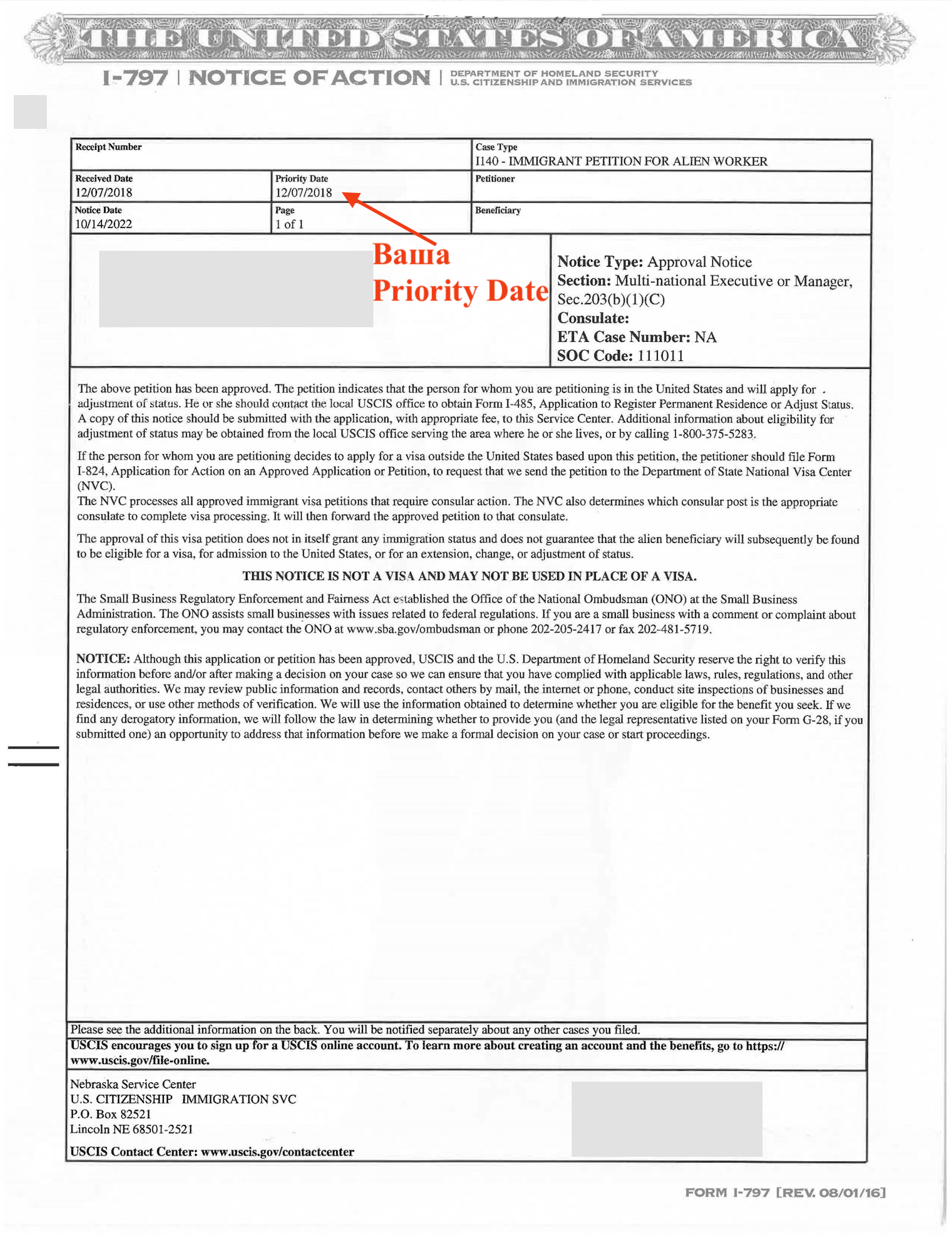
The priority date on your Form I-797
What is a priority date?
Usually it is the day USCIS received your I-140. If your employer went through PERM labor certification, it is the day the Department of Labor accepted that application. You keep the priority date of an approved I-140 for later EB-1, EB-2 or EB-3 petitions, say if you switch category or job. You lose it if USCIS revokes the approval for fraud, willful misrepresentation or a material error, or if the labor certification behind it is revoked or invalidated.
Your priority date can differ from the day USCIS actually started working on your petition.
Compare the dates.
Put your priority date next to the Final Action Date in the bulletin to see how close you are.
The Final Action Date is the cutoff in the bulletin: it shows which immigrant visa cases can move to a final decision right now.
What the result means.
If your priority date is earlier than the date in the chart that applies to you, a visa number is available and you can file. That does not mean you get the visa or green card at once, because the case still has to be decided. If your priority date is later, wait for the bulletin to reach it.
"All Chargeability Areas": what it means
Only four high-demand countries get their own column in the bulletin: China, India, Mexico and the Philippines. Every other country in the world falls under "All Chargeability Areas Except Those Listed", often shortened to "Rest of World" or ROW.
That includes Russia, Ukraine, Belarus, Kazakhstan, Georgia, Armenia, all of Europe, Canada, Japan, South Korea, Brazil, all of Africa and the rest.
Your country is set by where you were born, not by citizenship.
Born in Russia but hold a Kazakh passport? For the bulletin you are Russia, which is ROW. Born in India but living in Germany with a German passport? For the bulletin you are India, and in October 2026 the EB-2 Final Action Date for India is November 1, 2013. Your country of birth cannot be changed.
Cross-chargeability: an option for people born in India or China
If your spouse was born in a country with better dates, you can be charged to your spouse's country of birth instead. This is called cross-chargeability.
Example:
You were born in India, where the EB-2 line is longer than 12 years. Your wife was born in Russia, which is in the All Chargeability column. You can cross-charge to her country and wait by that column's dates.
Conditions:
- Both spouses have to immigrate together, at the same time. You cannot cross-charge and then file separately.
- It goes by country of birth, not citizenship.
- It works in both directions: the principal applicant can also use the country of birth of the derivative spouse.
Visa retrogression
What it is.
Retrogression means a cutoff date in the bulletin moves back instead of forward. It happens when a category or a country runs short of numbers, or when demand from some countries jumps.
Retrogression can be temporary. Dates can move forward again in later bulletins once more numbers open up or demand falls. Until then, people from the affected countries or categories wait longer.
USCIS explains retrogression here.
What happens to a filed case when dates retrogress, and what should you do?
USCIS does not finish a case while the applicant's priority date is no longer current. The application is put on hold until a number is available again.
While it waits, the file stays with USCIS. Where exactly depends on the case, but usually:
- If no interview is needed, the application stays at the USCIS office where it was filed.
- Employment-based cases that already had their interview are held at the National Benefits Center (NBC).
When your date comes back, USCIS may ask you for updated documents. That is why USCIS asks applicants to keep their address current and to report any change of address.
USCIS does not finish the case while your date is not current: it is put on hold until a number is available again. The file stays with USCIS, and when your date comes back USCIS may ask for updated documents, so keep your address current.
Rarely. For most countries EB-1 is almost always Current. Short retrogressions can happen in August-September, at the end of the fiscal year, and usually last one or two months.
History: how the EB-2 line appeared and where it stands now
The EB-2 dates jump around so much for a reason, and the history explains it.
Why is there a line at all?
Picture a movie theater with 140,000 seats, the minimum yearly number of employment-based green cards, plus unused family numbers. The seats are split between screening rooms: EB-1 (first preference), EB-2 (second), EB-3 (third) and so on. On top of that, no single country of birth can take more than 7% of the seats.
When fewer people want seats than there are seats, everyone walks in (Current). When more people want them, a line forms and you wait for your priority date. For India and China the room is always overbooked because so many people apply from there. For most other countries the room stayed half empty for years, but since late 2022 they have had lines too.
How it used to be: no line for years
Until late 2022, EB-2 for Rest of World was almost always Current. Once your I-140 was approved, you could file for the green card right away. There was no wait, and that was the norm for many years.
2022-2025: the first real line
In December 2022 something unexpected happened: for the first time in years, ROW got an EB-2 cutoff date. In practice it meant this. Before, you got the I-140 approved and filed the I-485 right away. Now you were told: "Your date is January 2023, but we are only serving November 2022. Wait."
A lot of people who were used to an instant process were caught off guard.
Timeline
Period | What the bulletin showed | What it meant in practice |
|---|---|---|
Before 2022 | Current | I-140 approved, file for the green card right away. No wait |
December 2022 | Cutoff: November 1, 2022 | First time in years: "your number has not come up yet, wait". A shock |
2023 | Cutoff dates in 2022 (April 1, 2022 in August 2023) | A real wait for the first time in years, unusual for ROW |
August 2025 | Cutoff moved back to September 1, 2023 | End of the fiscal year, numbers ran out. Retrogression |
October 2025 | Cutoff: December 1, 2023 | New fiscal year, new numbers, dates moved forward |
January 2026 | Cutoff: April 1, 2024 | Fast movement forward |
March 2026 | Current (Table B) | Final Action Date: October 15, 2024 |
April 2026 | Current (both charts) | No line (until October 2026) |
October 2026: with the start of fiscal year 2027, EB-2 dates for All Chargeability Areas went back again: Final Action Date January 1, 2025, Dates for Filing March 15, 2026. The State Department says it pulled back some employment-based dates for "Rest of World" to keep visa issuance within the quarterly and annual limits.
How EB-2 moved month by month in FY2026
How EB-2 reached Current in 7 months (All Chargeability Areas, which covers most countries):
Final Action Dates (Table A):
Month | EB-1 | EB-2 |
|---|---|---|
October 2025 | Current | December 1, 2023 |
November 2025 | Current | December 1, 2023 |
December 2025 | Current | February 1, 2024 |
January 2026 | Current | April 1, 2024 |
February 2026 | Current | April 1, 2024 |
March 2026 | Current | October 15, 2024 |
April 2026 | Current | Current |
EB-1 stayed Current for all 7 months of FY2026. EB-2 went from a December 2023 cutoff to Current in 7 months, a jump of more than two years. The biggest step came between March and April: from October 15, 2024 straight to Current.
Why the dates moved so fast in 2026
The State Department tied the movement to administration actions that reduced immigrant visa issuance at consulates:
1. Presidential Proclamation 10949 (June 2025) - entry restrictions for nationals of 19 countries
2. Presidential Proclamation 10998 (signed December 16, 2025, in force January 1, 2026) - the list grew to 39 countries
3. A pause on immigrant visas for nationals of 75 countries (from January 21, 2026) - a federal court set it aside on August 21, 2026
With fewer visas issued abroad, more numbers were left in the yearly employment-based pool, and the State Department moved dates forward so those numbers would be used before the fiscal year ended on September 30, 2026.
The April 2026 bulletin warned:
"...as additional immigrant visa demand materializes, or administration actions are amended, retrogression may be necessary later in the fiscal year to keep issuances within annual limits."
What this means for you: a fast run toward Current is not a promise. If you were waiting for EB-2 to open, a Current month is the time to file, because the next fiscal year can bring the cutoff back. That is exactly what happened in October 2026.
From January 21 to August 21, 2026, the State Department stopped issuing immigrant visas to nationals of 75 countries, Russia, Belarus and Kazakhstan among them. Interviews went ahead, but visas were not issued. A federal court set the pause aside on August 21, 2026 (CLINIC v. Rubio). Check the State Department's current notices before you plan travel. The official notice: immigrant visa pause for 75 countries (U.S. Department of State).
Glossary
Term | What it means |
|---|---|
Priority Date | Usually the day USCIS received your I-140 petition (with PERM, the day the Department of Labor accepted the labor certification). Your "number in line". Look for it on Form I-797 (Notice of Action) |
Final Action Date | The date in the bulletin (Table A) that shows which cases can be approved now |
Date for Filing | The date in the bulletin (Table B) that shows who can file the I-485 or DS-260 |
Current ("C") | Numbers are available, no line. You can file right away |
Unauthorized ("U") | No numbers this month, for any priority date |
Retrogression | Dates moved back. If your date stopped being Current, you wait |
Chargeability | The country you are "charged" to, set by your country of birth |
Cross-chargeability | Using your spouse's country of birth to get a better date |
I-140 | Immigrant Petition for Alien Workers - the first step |
I-485 | Application to adjust status - the second step, inside the U.S. |
DS-260 | Immigrant visa application - the second step, from abroad |
I-797 | Notice of Action from USCIS - it shows your priority date |
NVC | National Visa Center, which handles consular cases before the interview |
Employment-Based Preferences | The part of the bulletin with the work-based categories (EB-1 through EB-5) |
FAQ
What is retrogression?
Retrogression is when a date in the bulletin moves back. For example, the EB-2 Final Action Date for All Chargeability Areas was October 15, 2023 in July 2025 and September 1, 2023 in August 2025: a step back of about six weeks. It happens when the State Department sees that numbers will not last until the end of the fiscal year (September 30). Your petition is not canceled. You just wait longer.
What is the fiscal year and why does it matter?
The U.S. government's fiscal year runs from October 1 to September 30. A fresh set of visa numbers opens on October 1, so early in the fiscal year (October-December) dates often move forward, and near the end (August-September) they can move back as numbers run out. Not always, though: in April 2026, the middle of FY2026, EB-2 for ROW was Current, and in October 2026, the start of FY2027, ROW dates went back.
How often is the bulletin updated?
Once a month. It usually comes out around the middle of the month before: the November bulletin, for example, appears around mid-October. You can sign up for email updates on travel.state.gov.
I filed an I-140, but my date is not Current. What now?
You wait. Your priority date is locked in. Once the bulletin reaches it, you can file the I-485 (if you are in the U.S.) or start consular processing (if you are abroad). Check each new bulletin while you wait, because dates sometimes jump several months at once.
Does the bulletin affect EB-1 too?
Yes. For most countries EB-1 is almost always Current, but China and India have an EB-1 line too: in October 2026 the Final Action Date is July 1, 2023 for China and February 1, 2023 for India. Short retrogressions sometimes happen in August-September, at the end of the fiscal year, and usually last one or two months. For EB-1A and EB-1B applicants from Rest of World countries this is rarely a problem.
What does the letter "U" mean in the bulletin?
"U" stands for "unauthorized": no numbers can be issued in this category for this country right now. It happens, for example, when the annual limit has run out. You cannot file and have to wait for the next month, or for the new fiscal year on October 1. In the employment-based charts a "U" is rare and usually shows up near the end of the fiscal year.
What is Form I-797 and where do I find my priority date on it?
Form I-797 (Notice of Action) is the notice USCIS sends after you file, or after your I-140 is approved. The top of the notice shows your priority date, the day USCIS received your petition. After approval you keep that date (unless the approval is revoked for fraud or a material error), and it sets your place in the bulletin line. Compare it with the date in the bulletin: if yours is earlier, you can file.
What happens during retrogression if my I-485 is already filed?
If no interview is needed, the application waits at the USCIS office where you filed it. If you already had the interview, employment-based files are kept at the National Benefits Center (NBC). Once your date is current again, the review picks up where it stopped. USCIS asks you to keep your address current and to report any change.
How many employment-based green cards are issued each year?
At least 140,000 a year across all employment-based categories (EB-1 through EB-5), plus any family numbers left unused the fiscal year before. Each fiscal year starts on October 1 with a full yearly supply.
No single country of birth can take more than 7% of all family and employment numbers. In the October 2026 bulletin that cap is 25,620.
Have a question? Ask Vicky, the site's AI assistant, or join the free community chats (in Russian).
This page is part of O1EB1, a free education program of Global Talent Foundation Inc., a 501(c)(3) nonprofit. Our mission is to help talented professionals understand the O-1, EB-1A and EB-2 NIW visas using official sources. We sell nothing and do not give legal advice. About O1EB1
Disclaimer
This is an independent analysis of public sources: laws, regulations and USCIS decisions.
It is not legal advice. The authors are not licensed US attorneys. Using this site does not create an attorney-client relationship.
Immigration policy changes. Check the current rules on uscis.gov and discuss your case with a licensed immigration attorney.
O1EB1 news by email
Fresh news, tips on how to assemble your petition, ideas and recommendations. Sign up for the newsletter of the nonprofit project O1EB1.