

Form I-485 2026: adjustment of status steps, fees, timing
Form I-485 in 2026: how adjustment of status works, the $1,440 fee, documents, interview, processing times, and what the USCIS discretion memo changes.
Contents10
- Adjustment of status (Form I-485): the basics
- How does getting a green card through adjustment of status work?
- How long does Form I-485 take?
- How much does adjustment of status cost?
- Adjustment of status document checklist
- The 2026 USCIS memo: adjustment of status as "extraordinary" relief
- Adjustment of status: frequently asked questions
- Related pages
- Still have questions?
- Questions and answers from readers
Employment-based Form I-485 processing time now
As of October 20, 2026, USCIS data shows that 80% of employment-based Form I-485 applications are completed within 9.5 months at local USCIS field offices (EB-1, EB-2 and EB-3 cases) and 42.5 months at USCIS service centers (EB-4 and EB-5 cases only). The national median for all employment-based I-485 applications in FY 2026 is 6 months (USCIS leaves out applications affected by retrogression).
Check your date Saved for your next visit
Visa Bulletin for November 2026: travel.state.gov. Not legal advice.
| Measure | Time |
|---|---|
| USCIS field offices (All Field Offices), EB-1, EB-2, EB-3: 80% of cases | 9.5 months |
| USCIS service centers (SCOPS), EB-4 and EB-5 only: 80% of cases | 42.5 months |
| National median, FY 2026 | 6 months |
| National median, FY 2025 | 7.2 months |
"80% of cases" is the time in which USCIS completed 80% of such cases over the last six months, from filing to decision (how USCIS counts it). It is not a promise for your case.
The median is the time within which USCIS completed half of the cases in a fiscal year (FY 2026: October 1, 2025 to September 30, 2026). USCIS calculated it in September 2026 and says that for some forms it is counted differently from "80% of cases", so the two do not compare.
Source: USCIS, Check Case Processing Times, data as of October 20, 2026.
Source: USCIS, Historical National Median Processing Time, data as of September 2026.
USCIS updates its processing times every month. We update this table once a month.
New in 2026: USCIS now tells officers to treat adjustment of status as discretionary, "extraordinary" relief. What that means for O-1, EB-1A and EB-2 NIW applicants is in the section on memo PM-602-0199 below.
Adjustment of status (Form I-485): the basics
Below we cover what Form I-485 is, why it only works for people who are already in the U.S., and why filing it takes more care than it looks.
Adjustment of status (AOS), which means filling out and filing Form I-485, is how you change your immigration status inside the U.S. and get permanent residence (a green card) without leaving the country. In effect you ask USCIS to switch you from a temporary status to a permanent one. You can do it if you are in the U.S. lawfully and have a basis for a green card.
How does adjustment of status work?
Adjustment of status lets people who are already in the U.S. become lawful permanent residents without leaving. Most of them came on a nonimmigrant visa, such as a student, visitor or work visa, and now want permanent residence.
The alternative to adjustment of status is consular processing. There you apply for the green card from outside the U.S., and the case is handled by the U.S. embassy or consulate for your country, or by a designated post if your country has no U.S. embassy that issues immigrant visas.
Important for 2026: on May 21, 2026, USCIS issued policy memo PM-602-0199. It calls adjustment of status an extraordinary benefit that USCIS grants at its discretion, with consular processing as the ordinary route. If you came on a temporary visa and file an I-485 instead of leaving, the officer can count that against you, and you need clear positives to outweigh it. A clean record alone is not enough. The law itself did not change: adjustment of status still exists, and an officer who denies on discretion has to explain in writing why the negatives won. Details are further down this page.
Both routes, adjustment of status and consular processing, have their own timelines, forms, supporting documents and costs, but the eligibility rules are the same. If you are not sure which one fits you, read the comparison of the two below.
How does getting a green card through adjustment of status work?
- Check that you qualify for a green card.
- File the petition for your green card category yourself:
- For an employment-based case (EB-1 or EB-2), that is Form I-140.
- USCIS has to approve the petition. Without premium processing that takes a long time: on October 8, 2026, USCIS showed 32.5 months for 80% of EB-1A (E11) petitions. With premium processing, USCIS acts within 15 business days for EB-1A and 45 for EB-2 NIW. Check current times on the USCIS site.
- Once the petition is approved, check the Visa Bulletin to see whether a visa number is available for your category and country of birth. How the bulletin works, in detail.
- When the bulletin shows a number for you, file the adjustment application (Form I-485). You can also apply for a work permit and for advance parole, so you can work and travel while the case is pending.
Advance parole is a travel document (Form I-131) from USCIS that lets you leave the U.S. for a while and come back without abandoning your green card application. People use it for family emergencies, medical treatment, study or work trips. It is issued as part of adjustment of status, among other situations. Keep in mind that advance parole, like a visa, does not guarantee entry: you can still face extra questions and checks at the border when you return.
If you leave the U.S. while your I-485 is pending and you do not have advance parole, USCIS will usually treat the application as abandoned, and you would have to get an immigrant visa through a consulate instead. Advance parole avoids that on short trips abroad.
H-1B and L-1 holders have special travel rules (8 CFR 245.2) that let them leave and return without abandoning the green card application.
- After you file the I-485, USCIS schedules you for fingerprints and a photo (the biometrics appointment).
- Depending on what you put on the I-485 and on USCIS's checks, you may be called for an interview. If you are, the officer will ask about your application.
- If USCIS needs more evidence, it sends you a formal request (an RFE). Sometimes it also schedules a second interview.
If you do have an interview, the decision can come at the interview or later by mail. You can check your case status online at any time. If you are approved, you get an approval notice in the mail, and the green card itself follows soon after.
After you file, USCIS sends a receipt notice (Form I-797) with a receipt number. Use that number on Case Status Online. You can also open a USCIS online account (sign-up link in the top right corner) to see all your pending applications and petitions and their status in one place.
Another option is one of the many free case tracker apps, such as "Case Tracker for USCIS" (website | Android | iPhone).
Pick whichever you like: they all show the same USCIS status and mostly differ in design.
Yes, if your date is current: this is concurrent filing, one package in one envelope. The risk the page describes: if the I-140 is denied, the I-485 fee ($1,440 by mail) is not refunded.
The EAD (Form I-765) is a work permit. Advance parole (Form I-131) is a travel document that lets you leave the U.S. for a while and come back without abandoning your green card application. Both can be filed together with the I-485.
How long does Form I-485 take?
USCIS publishes how long it takes to finish 80% of cases, counted over the last six months. The current numbers for employment-based Form I-485 are in the box at the top of this page, and we update them every month. EB-1, EB-2 and EB-3 applications are decided by USCIS field offices, so the field office figure is the one that applies to them.
Your own case can be much faster or slower. The posted times leave out cases waiting for a visa number, and the I-485 cannot be approved until your priority date is current under the Final Action Dates chart, so in a category with a line the wait for the bulletin comes on top of this.
How much does adjustment of status cost?
Form I-485 is one of the most expensive USCIS filings. The fee depends on your age and on how you file: $1,440 by mail or $1,390 online. Children under 14 who file together with a parent pay $950 by mail or $900 online. The separate $85 biometrics fee was dropped on April 1, 2024, because it is now part of the filing fee. Fees change from time to time, so check the current amounts on the USCIS site before you file.
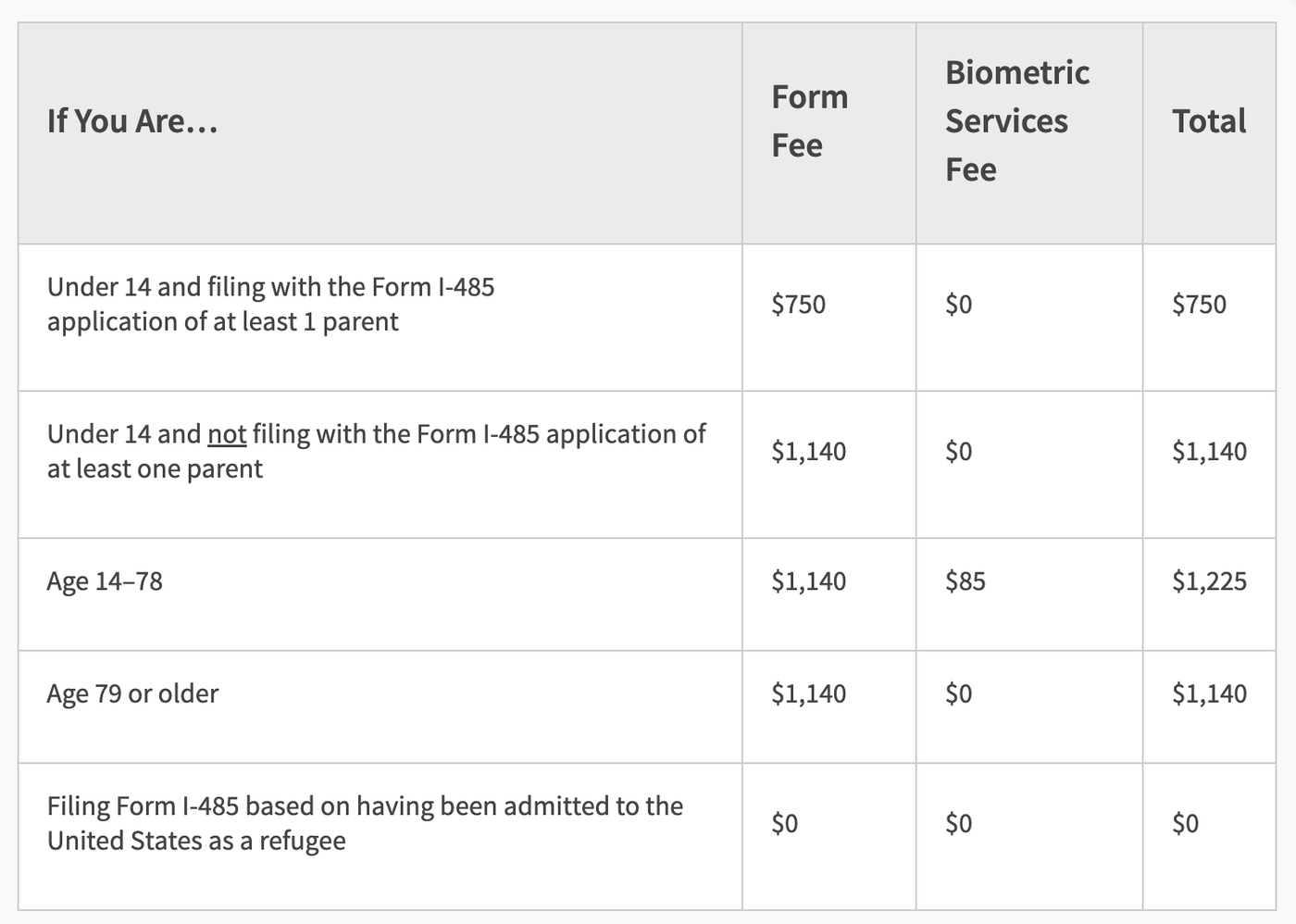
Screenshot from the USCIS site (May 7, 2023). The amounts on it are outdated; the current ones are listed above.
No. USCIS filing fees are not refunded, which is why concurrent filing with an I-140 that might be denied is a risk: you would lose the I-485 fee ($1,440 by mail).
Yes, for an I-485 filed with its fee on or after April 1, 2024: the I-765 costs $260 and the I-131 $630 by mail or $580 online. If your I-485 was filed and paid before April 1, 2024 and is still pending, there is no USCIS fee for them.
Adjustment of status document checklist
Below is a sample list of documents for adjustment of status. The full list is on the USCIS site.
- Two passport-style photos;
- A copy of a government photo ID and of your valid U.S. visa;
- A copy of your birth certificate with a certified English translation
- Your arrival/departure record, Form I-94
- Proof of your immigrant category, such as a copy of the I-797 approval notice;
- Proof of a job offer (Form I-485 Supplement J, if it applies to you);
- Your medical exam results on Form I-693, in an envelope sealed by the civil surgeon. Since December 2, 2024, Form I-693 has to be filed together with the I-485, or USCIS can reject the application.
- If you self-petitioned, a signed statement that you intend to work in the field named in your Form I-140;
- For an EB-1 or EB-2 case you may also need a copy of the I-140 receipt or approval notice (or the I-140 itself if you file both together) and, if you want a work permit, Form I-765.
Use the current edition of Form I-485 (09/18/26): since September 18, 2026, USCIS rejects older editions, because the form was revised for the new public charge rule. On October 7, 2026, USCIS also changed the mailing addresses for Form I-485. For details on each form, go to the USCIS site and the form's own page. For Form I-485, start here.
The 2026 USCIS memo: adjustment of status as "extraordinary" relief
On May 21, 2026, USCIS issued policy memorandum PM-602-0199. It is six pages long. It does not change the law or any regulation: section 245 of the INA still lets people adjust status. What it changes is how officers are told to use their discretion. The memo says that where consular processing is available in your category, officers should treat adjustment of status as an extraordinary act of administrative grace, not as the normal path.
What the memo says
- Officers weigh all positive and negative factors in the totality of the circumstances: family ties, immigration status and history, moral character and anything else relevant.
- Status violations, overstays, unauthorized work, and coming on a temporary visa and filing instead of leaving count as negatives. They weigh more when you could have gone through a consulate instead.
- A clean record alone is not enough. Page 5: "The absence of adverse factors, by itself, does not demonstrate such unusual or outstanding equities."
- Filing an I-485 is not in conflict with holding a dual intent status such as H-1B or L-1. But footnote 20 adds that keeping that status is "not sufficient, on its own, to warrant a favorable exercise of discretion."
- If USCIS denies on discretion, the denial notice has to list the positive and negative factors and explain why the negatives won.
- USCIS says it may issue more guidance for specific categories and groups of applicants. The rules officers follow are in the Policy Manual, Volume 7, Part A, Chapter 10.
What it means for O-1, EB-1A and EB-2 NIW
EB-1A and EB-2 NIW. These categories are built around benefit to the U.S. A USCIS spokesperson told the BBC in May 2026 that applicants "who present applications that provide an economic benefit or otherwise are in the national interest will likely be able to continue on their current path". That is a statement, not a rule. In practice, use the same evidence that won your I-140, your extraordinary ability or the national importance of your work, a second time: this time as the positive factors that justify a favorable decision.
O-1. The O-1 is not formally a dual intent status, but the regulations let you hold it while you pursue a green card. Lawyers who wrote about the memo mostly put it in the middle: more exposed than H-1B and L-1, less exposed than TN, E-3, F-1, J-1 and visitor status.
Visitors and students. If you entered on a B-1/B-2 or F-1 and then filed, you are the most exposed. USCIS can argue that you meant to stay from the start (preconceived intent).
The two old decisions behind the legal fight
In Matter of Arai (1970) the Board of Immigration Appeals wrote:
"In the absence of adverse factors, adjustment will ordinarily be granted, still as a matter of discretion."
Four years later, in Matter of Blas (1974), about a visitor who misled the consular officer about his plans, the same Board called adjustment an extraordinary form of relief, and in the same decision it reaffirmed Arai. The 2026 memo cites Blas and does not mention Arai. Critics of the memo also point to section 245(k), which tolerates up to 180 days of status violations in employment cases, and the Administrative Procedure Act, which limits how far an agency can change policy without formal rulemaking. On October 5, 2026, unions, faculty groups and six applicants sued over the memo in federal court in Massachusetts (AAUP v. Mullin, No. 1:26-cv-14527). Check the case status before you rely on the memo either way.
If you are filing an I-485 now
- Treat the I-485 as a full case, not a formality. Add a short cover statement of your positive factors: your work and its benefit to the U.S., your status history, tax filings, family ties, with documents for each.
- Keep your nonimmigrant status valid while the I-485 is pending if you can (H-1B, L-1, O-1).
- If you entered on a visitor or student visa, talk to a licensed immigration attorney before filing. Consular processing may be the safer route for you.
- If you are denied on discretion, the written analysis USCIS has to give you is what a lawyer works from for a motion or a new filing.
Not legal advice
This section is an educational summary of a public USCIS document and of published commentary on it. We are not lawyers. For your own case, talk to a licensed U.S. immigration attorney.
Memo PM-602-0199 tells officers to treat adjustment of status as discretionary, extraordinary relief where consular processing is available. It matters most for people who came on a temporary visa and file an I-485 instead of leaving. The law itself did not change.
The page does not decide that for you. Its practical points: treat the I-485 as a full case, add a cover statement of your positive factors, keep your status valid if you can, and if you entered on a visitor or student visa talk to a licensed attorney first.
Adjustment of status: frequently asked questions
- What is Form I-485 for?
Form I-485 is the application to adjust status. People who are in the U.S. on certain temporary visas and qualify for a green card file it to move from nonimmigrant to immigrant (permanent resident) status. - When should I file Form I-485?
You can file the I-485 together with the I-140, while the I-140 is pending, or after it is approved, but only when the Visa Bulletin shows a number available for your category and country of birth (USCIS posts on its site which chart to use each month). Keep in mind that it is safest to file the I-485 before your I-94 expires. For EB-1, EB-2 and EB-3, section 245(k) forgives up to 180 days in total out of status since your last lawful admission. - How much is the I-485 filing fee?
The I-485 fee is $1,440 by mail and $1,390 online. There has been no separate $85 biometrics fee since April 1, 2024: it is included. Since October 28, 2025, USCIS no longer takes paper checks or money orders, so a paper filing is paid by card (Form G-1450) or by debit from a U.S. bank account (Form G-1650), unless you qualify for an exemption (Form G-1651). Some applicants pay less or nothing:
1) Applicants 79 and older used to skip the biometrics fee. Now there is no separate biometrics fee, so that discount is gone.
2) There is no fee if you file the I-485 because you were admitted to the U.S. as a refugee.
3) There is no fee for refugees adjusting under section 209(a) of the INA.
4) Applicants under 14:
A: filing together with at least one parent's I-485, the fee is $950 by mail or $900 online.
B: filing without a parent's I-485, the full fee applies: $1,440 by mail or $1,390 online. - What vaccination records do I need for the medical exam?
At the medical exam you have to show records that you are vaccinated against a set of diseases: mumps, measles, rubella, polio, tetanus and diphtheria, pertussis, seasonal flu, hepatitis A, hepatitis B, varicella, Haemophilus influenzae type b (Hib), rotavirus, meningococcal disease and pneumococcal disease. If your records do not show a full series and you have no other proof of immunity, the civil surgeon gives you the missing dose at the exam. If one dose does not complete the series, the doctor can note a waiver for medical reasons, so you are not denied just because the series could not be finished. - How long is my medical exam valid?
The rules have changed several times. Today (USCIS Policy Manual, Volume 8, Part B, Chapter 4) a Form I-693 signed by the civil surgeon on or after November 1, 2023 stays valid for as long as the I-485 it was filed with is pending. If that I-485 is withdrawn or denied, a new filing needs a new I-693. A form signed before November 1, 2023 is valid for 2 years from the doctor's signature. The old rule that the form had to be signed no more than 60 days before you filed was dropped on March 31, 2023. The older rule worked like this: if you filed a completed Form I-693 with USCIS between November 1, 2018 and December 9, 2021, it was valid to show that your health was not a ground of inadmissibility if one of the two conditions below was met.
In other words, the I-693 counted if the civil surgeon signed it no more than 60 days before you filed, or signed it after you filed, and in either case USCIS decided the application within 2 years of the doctor's signature.
Under that old rule, a form signed more than 60 days before the I-485 was filed was not enough on its own when it reached USCIS.
Our detailed guide to medical exams for O-1, EB-1 and EB-2 is here (in Russian).- The civil surgeon signed Form I-693 no more than 60 days before you filed the underlying application with USCIS, and USCIS decided the application no more than 2 years after the civil surgeon signed.
- The civil surgeon signed Form I-693 and you submitted it after filing the underlying application with USCIS, and USCIS decided the application no more than 2 years after the civil surgeon signed.
- What do I need to do after filing Form I-485?
A 1997 law requires fingerprints for adjustment of status. They are taken at a USCIS office or by a designated state or local law enforcement agency. - Where are fingerprints taken, and what should I bring?
In most cases at an Application Support Center (ASC). Bring the appointment notice and a valid photo ID, such as a passport or a state driver's license. After the appointment USCIS sends your fingerprints to the FBI for a check, and the FBI response has to come back before USCIS can decide the adjustment case. - How long does the FBI clearance take after my fingerprints?
It usually shows up in the USCIS system within about thirty days. - How long is the clearance valid?
The FBI fingerprint result is valid for 15 months. After that you have to give fingerprints again. - Can I apply for a work permit (EAD) or for advance parole together with the I-485?
Yes. If you need permission to work or to travel, you can file those applications with the adjustment application. The work permit is Form I-765 and advance parole is Form I-131. You can send them together. If you file the I-765 or I-131 later, separately, include a copy of your I-797C receipt notice as proof that the I-485 is pending. - Do I pay extra for the EAD and advance parole if I file them with the I-485?
Yes. Since April 1, 2024 they are paid separately. If your I-485 was filed with its fee on or after April 1, 2024, the I-765 costs $260 and the I-131 for advance parole costs $630 by mail or $580 online. If your I-485 was filed and paid before April 1, 2024 and is still pending, there is no USCIS fee for the I-765 and I-131. - How is an I-485 processed?
The application first goes to a USCIS lockbox or service center. The next thing you get is the biometrics appointment notice: you are scheduled at your local Application Support Center (ASC) for fingerprints, which are then sent to the FBI and checked against law enforcement databases. USCIS may also write to you if documents are missing or unclear, for example proof of a family relationship. That is a Request for Evidence (RFE), and you have up to twelve weeks to answer it. Since December 2, 2024, the medical exam (Form I-693) goes in with the I-485 instead of being brought to the interview later.
RFE stands for "Request for Evidence". It means USCIS wants more information or documents before it can decide your application. If you get one, send what it asks for or answer its questions by the deadline. Otherwise your application can be denied.
- What checks does USCIS run on an I-485?
Several: - The petition is checked against USCIS's index of fraudulent petitions, which keeps track of earlier filings where fraud was found.
- Your biographic data (names) is run through an interagency database of people with past immigration problems or possible security concerns.
- Petitions filed together can also be compared with existing files on the applicant or beneficiary, to see whether the information matches what was said before.
- USCIS can also check that supporting documents are genuine against its foreign document reference guides. If it doubts a document, it can ask for the original.
- For the related benefits (work permit and travel), USCIS does a prima facie review of any I-140 filed together with the I-485 before it decides the I-765 or I-131. What does that mean? A prima facie review is a first-look check of the filing: USCIS confirms that the required documents are there and meet the minimum requirements, without a deep review. It is not a decision on the petition.
So before USCIS acts on the work permit or travel document, it first looks at what you filed for the green card itself. - Is an interview required for adjustment of status?
USCIS said in 2017 that it would interview employment-based adjustment applicants, starting with cases filed on or after March 6, 2017, unless it decides to waive the interview case by case. The interview lets USCIS confirm key information about you. - What should I bring to the interview?
Applicants who need an interview get an appointment notice in the mail after filing and biometrics. It gives the time and place and lists the documents to bring.
If you have an interview, be ready to bring:- the medical exam results on Form I-693 (if you did not file them with the application);
- your passport;
- Form I-94;
- the originals of all your documents;
- an updated letter from your employer confirming your position and salary;
- all documents related to the petition, if it was filed together with the adjustment application;
- the interview notice
- How does the interview go? What do they usually ask?
After you take the oath, the officer goes through the biographic information on your I-485, checks it and fixes any errors. Questions you may hear:
1) The questions on the form about grounds of inadmissibility.
Inadmissibility is the legal term for not being allowed to enter or stay in the U.S. It can come from immigration violations, crimes, certain health grounds or other reasons in the law.
Officers ask about it at the interview because inadmissibility can be a reason to deny adjustment of status. They want to confirm that you meet the requirements and that nothing bars you from living in the U.S.
2) You may be asked about your basis for permanent residence, such as the job offer if your case is based on a new job.
3) If you were in the U.S. for a long time without a job, the officer will likely look closely at how you supported yourself, to make sure you did not work without authorization.
- What happens if my application is not approved at the interview?
If it cannot be approved at the interview because you need to send more information or some clearances are still pending, you wait until those are resolved before the approval notice goes out. - When will I get the approval notice? Can I travel abroad or start work once I have it?
The approval notice (Form I-797) is sent after the State Department (DOS) assigns a visa number. USCIS then orders your permanent resident card (Form I-551). The I-797 approval notice on its own is not enough proof of permanent residence to travel abroad and come back as a resident, or to show that you are allowed to work.
DOS is the U.S. Department of State. Among other things it runs U.S. consulates and embassies, issues visas, publishes the Visa Bulletin and helps U.S. citizens abroad.
- What if my spouse and children are still in my home country? Will they get visas?
Yes. Once you have adjusted status, your spouse and unmarried children under 21 can get immigrant visas at the U.S. consulate that handles immigrant visas for the country where they live. For residents of Russia, for example, that is the U.S. Embassy in Warsaw, per the State Department's list of posts. This is called "following to join". You ask USCIS to notify that consulate that you have become a permanent resident.
"Following to join" covers a spouse or child who was not part of your original immigrant case and joins you in the U.S. after you got your green card. They use the following-to-join process to get their own immigrant visas.
- Can I change employers while my I-485 is pending? Will that affect my I-140?
Under AC21 portability, if your I-485 has been pending for 180 days or more, you can change jobs or employers without losing the underlying I-140 or labor certification, as long as the new job is in the same or a similar occupational classification. - What if I want to go back to my home country while the I-485 is pending? Can I switch to a consulate after filing?
Yes. If you decide you would rather get the visa abroad, you need extra steps so the case can be handled outside the U.S. In particular, you file Form I-824 with the USCIS office that approved your petition and ask it to notify the consulate of the approval. - What if my application is denied? Can I appeal?
A denial has to come in writing with the reasons. If your nonimmigrant status is still valid, you can stay on that status. If not, you may face removal after an I-485 denial. You cannot appeal an I-485 denial, but you can file a motion to reopen or reconsider with USCIS, based on a legal argument or on new facts that were not available at the time and that bear on the reasons for the denial. - How much did USCIS raise fees in 2024?
In 2023 USCIS proposed higher fees for most applications, including adjustment of status. The new fees took effect on April 1, 2024. The I-485 now costs $1,440 by mail or $1,390 online, and the I-765 and I-131 filed with an I-485 are paid separately. For current amounts, see the USCIS fee schedule (Form G-1055).
Archived USCIS page about the proposed rule (2023).
What is the difference between "unlawful status" and "unlawful presence", and why does it matter for adjustment of status?
Under sections 212(a)(9)(B) and 212(a)(9)(C)(i)(I) of the Immigration and Nationality Act (INA), there is a difference between
- Unlawful status - being out of status
and - Unlawful presence - building up days of unlawful presence (time in the U.S. that is not authorized)
The two are linked (you have to be out of status to build up unlawful presence), but they are not the same thing. USCIS's former Adjudicator's Field Manual, in sections 40.9.2(b)(2) and 40.9.2(b)(3), says there are situations in which a person who is out of status still does not accrue unlawful presence. As a matter of prosecutorial discretion, DHS (U.S. Department of Homeland Security) can let someone who is in the U.S. without status, but who has filed an application that stops unlawful presence from accruing, stay while that application is pending. In that sense the person's stay is "authorized". Still, not accruing unlawful presence does not make the stay lawful.
Here it is in plain words, with examples taken from that USCIS document (pages 57-59)
Example 1.
Someone comes to the U.S. on a nonimmigrant visa, say as a visitor, and the Form I-94 says to leave by January 1, 2023. They do not leave. From January 2, 2023 their stay is unlawful and unlawful presence starts adding up. Then on May 10 their I-140 is approved and they file an I-485. Filing stops new days of unlawful presence from adding up, but the person is still out of status and can be removed, because they stayed past the date on the I-94.
This example comes from the USCIS document (page 58).
Example 2.
Someone enters on a nonimmigrant visa, and their Form I-94 says to leave by January 1, 2023. On October 5, 2022 they file an I-485 but do not ask to extend their temporary status. On January 1 the admission period ends and the I-485 is still pending.
From January 2, 2023 they can be placed in removal proceedings, because they stayed after their admission period ended. But because the I-485 is pending, they do not accrue unlawful presence, which could otherwise make them inadmissible later.
The Immigration and Nationality Act has a very handy section, 245(k), that changes how "unlawful status" and "unlawful presence" play out for employment-based cases. It creates exceptions.
This example comes from the USCIS document (page 58).
Section 245(k) forgives short status violations when you adjust from nonimmigrant to immigrant status (the I-485). It lets most employment-based applicants (EB-1, EB-2, EB-3) adjust status even if they were out of status, worked without authorization or otherwise broke the terms of their admission, as long as all of those violations add up to no more than 180 days. It does not cure everything, though. Entry without inspection (crossing the border without being checked) and the various grounds of inadmissibility can still block adjustment.
The 180 days are counted from your last lawful admission to the U.S. So if you built up 10 days of violations, left, came back, built up another 15 days and then filed, the 10 days from the first stay are not counted.
Example 3.
Someone comes to the U.S. in lawful nonimmigrant status, say as a visitor. While still in status, they prepare and file an EB-1 petition on Form I-140. It is approved, and they file an I-485. While the I-485 is pending, their work permit (EAD) expires and they do not renew it, but they keep working. That unauthorized work goes on for more than 180 days.
Here is the key part: even though they worked without authorization for more than 180 days, they are not inadmissible under section 212(a)(9)(B), because the pending I-485 stops unlawful presence from accruing. They did not build up a "bad record" just by waiting for a decision. And since they never left the country, the section 212(a)(9)(B) bar, which applies when a person departs after unlawful presence, does not come into play.
But there is another problem: section 245(k) does not protect them from the section 245(c)(2) bar, because they worked without authorization for more than 180 days. So even without unlawful presence, they violated their status by working without permission, and that can stop them from adjusting to permanent residence.
This example comes from the USCIS document (page 59).
I-485: the status did not change, but the case shows as updated. What does that mean?
USCIS sends its decisions as written notices, and a decision also changes the status title. If the status title is the same and there is no new notice, the "updated" mark alone tells you nothing, and it is not a sign of approval or denial.
Watch your status on Case Status Online and the notices in your USCIS account. If your case is taking longer than the posted time (USCIS Processing Times), you can send an inquiry through e-Request.
Related pages
- Visa Bulletin for EB-1 and EB-2: how to read it and when to file the I-485
- The EB-2 retrogression in October 2026: what happens to a filed I-485
- Success stories (1): 57 EB-1A cases, from denial to approval (in Russian)
Still have questions?
Questions people ask after their I-140 is approved: "How long until the EAD arrives?", "Can I really fly home on advance parole and come back?", "My category is current this month - should I file now or wait?". How the EB-2 dates moved month by month. Join our community on Telegram (Russian-speaking).
Ask Vicky, the site's AI assistant, or bring your question to the free community chats (in Russian).
Questions and answers from readers
Self-filing EB-2 NIW without a lawyer and working remotely for a foreign company during adjustment: is that legal?
Question: Here is what I cannot figure out. If I enter on a B-1/B-2, self-file EB-2 NIW without a lawyer and file for adjustment at the same time, can I keep working remotely for a corporation in Serbia? The corporation has entities in both Serbia and the U.S., but I would work for the Serbian entity: salary from there, employment contract there. Logically it is not a "gray zone", since the employer is foreign and has nothing to do with the U.S. job market. But how legal is it under U.S. rules while my adjustment is pending? An internal transfer may not happen fast, which is why I am asking about this option.
Reader's answer:
I also could not find a clear answer anywhere on remote work for a foreign employer while adjustment is pending. Formally you can file for an EAD right after the I-485, but until it arrives it is a gray zone. The foreign-employer argument makes sense: pay from Serbia, contract there. But I have heard that lawyers disagree on exactly this point. Some say it is fine, others say it is risky because you are physically in the U.S.
I-485 concurrent filing: what did the whole package cost before and after the April fee increase?
Question: I want to file I-485s for myself and my husband with all the other forms, work permit and so on, so it would be concurrent filing. I cannot find clear numbers for two people. What did a package like that cost before April 1, and what does it cost after? Is the difference big?
Reader's answer:
Before April 1, 2024 it was $1,225 per person (I-485 $1,140 + biometrics $85), and the I-765 and I-131 were included. Now each is separate, per person: I-485 $1,440 by mail or $1,390 online (biometrics included), I-765 with a pending I-485 $260, I-131 for advance parole $630 by mail or $580 online. The medical exam (I-693) is paid to the doctor separately.
Reader's answer:
Always check the amounts against the official USCIS fee schedule.
Fees per G-1055 (edition 10/16/26):
- I-485 - $1,440 by mail / $1,390 online.
- I-765 (EAD) filed with a pending I-485 - $260
- I-131 (advance parole) filed with a pending I-485 - $630 by mail / $580 online.
https://www.uscis.gov/sites/default/files/document/forms/g-1055.pdf - every amount is listed there officially.
Filing I-485 concurrently for EB-2 NIW while the I-140 is still pending: is that possible?
Question: Can I file an I-485 under EB-2 NIW if my petition was filed a couple of years ago and is still pending? I have heard of concurrent filing, where you file together with the I-140, but it is unclear whether it works if the I-140 is already in process. How long did people wait after filing the I-485 this way?
Reader's answer:
You can file the I-485 only when the chart USCIS uses that month shows Current or a date later than your priority date. In October 2026 that is the Dates for Filing chart, where EB-2 for All Chargeability Areas is March 15, 2026, so an older pending NIW petition may already qualify. Concurrent I-140 + I-485 works well for EB-1, which is current for everyone except India and China. Several petitions in different categories can exist at the same time, so if your evidence is strong enough, you can file an EB-1 I-140 in parallel and file the I-485 as soon as it is approved, without waiting in the NIW line.
Reader's answer:
Thanks, concurrent filing makes more sense now. Do you know roughly when EB-2 NIW will be current?
Reader's answer:
Yes, if you filed while the date was current and then it retrogressed, you just sit and wait until the final action date opens again.
Reader's answer:
One thing people rarely mention: when the date finally opens, you do not have to file right away. My lawyer explained it to me: while you have a normal status, a pending I-485 adds a restriction. You cannot leave the country without advance parole, and if you leave without it, the I-485 is treated as abandoned. If you travel a lot, that really matters for timing.
Reader's answer:
On consular processing: if there is a risk your status ends before your date becomes current, decide that at the start, not later. I am going EB-1 and my lawyer told me right away: for adjustment you generally need to be in status when you file the I-485 (section 245(k), explained above, forgives up to 180 days of violations in employment-based cases); otherwise consular processing is the route. The downside of consular processing is no EAD or advance parole while you wait, but you are not tied to being in the U.S. and can travel without risking the application.
Reader's answer:
By the way, if you have an O-1, take a serious look at EB-1. The lawyers who did my O-1 kept pushing NIW for some reason, even though my case clearly fit EB-1. For ROW, EB-1 is current right now, so the whole bulletin and dates story does not apply.
Reader's answer:
On the I-485 itself, EB-1 and EB-2 NIW go through the same process. The real difference is when you are allowed to file at all. For ROW, EB-1 is current now, so you file right after the I-140 approval. For EB-2 NIW you wait until the bulletin reaches your date. So if you count the full cycle up to the green card, EB-1 really is faster, simply because there is no line for the priority date.
Reader's answer:
Premium processing on EB-1 changes the math a lot. My lawyer explained that with premium, an EB-1A I-140 takes 15 business days, and you can file the I-485 right away while ROW is current. NIW has premium too, but it helps less: you still wait for the bulletin to reach your priority date, so it only speeds up the petition stage, and then you wait the same months.
EAD and travel document on an O-1: does that mean the I-140 was approved?
Question: If someone got a work permit and a travel document, does that mean their I-140 was approved? This is about filing for a green card from O-1 status.
Reader's answer:
There are many grounds for an EAD, but I-140 approval is not one of them. Usually people get the EAD and travel document after filing the I-485 (adjustment of status). If they arrived, the I-485 is definitely pending, but check the I-140 status separately on the USCIS site: with concurrent filing it may still be pending.
Reader's answer:
Got it, thanks. How do I check the I-140 status? With the same number as the I-485, or does it have its own receipt?
Reader's answer:
With concurrent filing there is one thing not everyone considers: the I-140 can be denied while the I-485 is already in process. That is exactly what happened to me. I filed the 140 and 485 together, the 485 was taken up, then the 140 was denied, and the 485 denial followed automatically. So having an EAD in hand does not mean the 140 was approved.
The I-140 decides whether you qualify for the green card category, whether you meet the criteria. The I-485 is the green card application itself, where they check your documents. Each has its own receipt number and its own status.
Reader's answer:
On my first filing the EAD came, then the 140 denial arrived and everything fell apart.
I-485 (EB-1): the progress bar disappeared from my USCIS account. What does it mean?
Question: The progress bar for my I-485 (EB-1) disappeared from my USCIS account. I filed for adjustment of status, everything was going normally, and then the bar just vanished. What could it mean: a request for more documents, a denial, or just a system glitch?
Reader's answer:
A couple of weeks ago my I-485 page showed the same thing: myProgress information is unavailable, we appreciate your patience while we work to restore this service. It is a system issue, not something about your case. My lawyer said the bigger question now is the 2026 USCIS memo on adjustment of status, but that has nothing to do with how progress is displayed.
Reader's answer:
Thanks, that helps. So I just wait and stop worrying.
Reader's answer:
The progress bar tells you nothing about how fast your own case will move.
Reader's answer:
The estimate jumps around a lot. The progress bar is definitely not about your specific case. It is system-wide.
Reader's answer:
On working while the I-485 is pending: with concurrent filing you could send the I-765 for an EAD and the I-131 for advance parole together. If you did not, you can file them separately now. Once the EAD is approved, you can work for any employer while the I-485 is pending.
Reader's answer:
If you are on an O-1, the gap between the O-1 and the EAD is not that scary. An I-140 does not cancel your O-1 work authorization: the status runs to its end date whatever happens to the petition. I asked my lawyer about this exact point: until the EAD is approved, you keep working on the O-1 as before, and the petition does not affect the status.
Reader's answer:
One more thing about concurrent filing: there is a real financial risk. If the I-140 is not approved, the I-485 fee is lost, and that is a lot of money. That is exactly what happened to me. I filed the I-140 with premium processing, got an RFE, then a denial, and the I-485 fee was gone. I extended my O-1 with a different sponsor, filed EB-1 again without premium, and filed the 485 only after that approval.
Reader's answer:
My second EB-1A filing (the story is in Russian) was approved in the end. The first got an RFE and then a denial. I waited for the I-140 approval and only then filed the 485, exactly so I would not risk the fee. So it really can be done, it is just nerve-racking and slow.
Reader's answer:
I went through PM-602-0005 when I was putting my EB-1 package together, and my lawyer explained the same thing. Four criteria just barely met is a risk at the second step, where the officer does not go by a checklist but looks at everything together. In the end I put six criteria in the package, exactly so there would be something to show at the final step.
Reader's answer:
With premium, my I-140 was approved within the premium period, with no RFE. I filed the I-485 only after that, on purpose, so I would not lose the fee.
Reader's answer:
In my RFE none of my three prongs were accepted, only my education counted. I expected something might not be accepted, but all three was a surprise. In the petition I started from far away, walking the officer through the industry. That probably worked against me: with a long lead-in, at the final step they look at the totality and see filler instead of evidence.
I-140 + I-485 concurrent filing: one package or two separate ones?
Question: Do I understand correctly that filing the I-485 concurrently with the I-140 is one joint filing, not two separate applications? I cannot work out whether to send them separately or in one envelope. I got stuck on this while preparing the documents.
Reader's answer:
Concurrent filing is one package, one address, one mailing date. The I-140 and I-485 go in the same envelope. The risk is that if the I-140 is denied, you lose the I-485 fee ($1,440 by mail), because it is not refunded. I went back and forth on filing together or waiting for the I-140 approval first, and in the end decided not to take the risk.
Reader's answer:
If you do go with concurrent filing, you can add the I-765 for a work permit and the I-131 for advance parole to the same package. Then you wait for the I-140 approval and the work permit at the same time. The mailing address is different from the one for a standalone I-140: the USCIS site has a separate direct filing addresses section for an I-485 filed with an I-140, so check there.
EAD in EB-1: only after the petition is approved, or can I apply sooner?
Question: Am I right that in EB-1 a work permit is possible only after the case is approved? So the EAD is issued only between the petition approval and the arrival of the green card? Or is there a way to get work authorization earlier?
Reader's answer:
In EB-1 you can file the I-485 together with the petition, and the EAD is issued while the I-140 is still pending, so you do not have to wait for approval. NIW works the same way when the priority date is current. When EB-2 has a line, you wait until the chart USCIS uses that month reaches your priority date, and only then file the I-485 and get the EAD based on it. I am on NIW myself, and I cannot file the I-485 right now because of the line, so I am waiting for my priority date to become current.
I-765 filed concurrently with the I-485: a year of waiting for the EAD and nothing
Question: I filed the I-765 with a pending I-485 and I-140 through concurrent filing. It has been a year with no result: no requests, nothing at all. What has your experience with wait times been in a similar situation? Is this normal, or is it worth doing something?
This page is part of O1EB1, a free education program of Global Talent Foundation Inc., a 501(c)(3) nonprofit. Our mission is to help talented professionals understand the O-1, EB-1A and EB-2 NIW visas using official sources. We sell nothing and do not give legal advice. About O1EB1
Disclaimer
This is an independent analysis of public sources: laws, regulations and USCIS decisions.
It is not legal advice. The authors are not licensed US attorneys. Using this site does not create an attorney-client relationship.
Immigration policy changes. Check the current rules on uscis.gov and discuss your case with a licensed immigration attorney.
O1EB1 news by email
Fresh news, tips on how to assemble your petition, ideas and recommendations. Sign up for the newsletter of the nonprofit project O1EB1.